
What is this
Every Thursday, I will share a dev diary about what we’ve been working on over the past few weeks. I’ll focus on the interesting challenges and solutions that I encountered. I won’t be able to cover everything, but I’ll share what caught my interest.
Why am I doing it
I want to bring our community along on this journey, and I simply love writing about things I’m passionate about! This is my unfiltered dev journal, so please keep in mind that what I write here are my thoughts and will be outdated by the time you read this, as so many things change quickly. Any plans I mention aren’t set in stone and everything is subject to change. Also, if you don’t like spoilers, then don’t read this.

Space Engineers 2
VS2.3 First Contact: Direction, Results, and What We Are Fixing Next
VS2.3 is out, and first I want to say thank you.
Thank you to everyone who jumped in immediately, built vehicles, tested automation, exploded things, tried Classic Survival, reported bugs, and told us what worked and what did not.
This is exactly why Early Access matters. We do not want to build Space Engineers 2 in isolation. We want the game to meet real players as early as possible, because only then do we see what is truly clear, fun, confusing, fragile, or exciting.
The first response is encouraging. Players are not just reacting to individual blocks. They are already thinking in systems again: rovers, mobile bases, automation chains, warheads, survival routes, contracts, stations, and even requests for future things like rails and trains. That is a good sign. It means VS2.3 is touching the right fantasy.
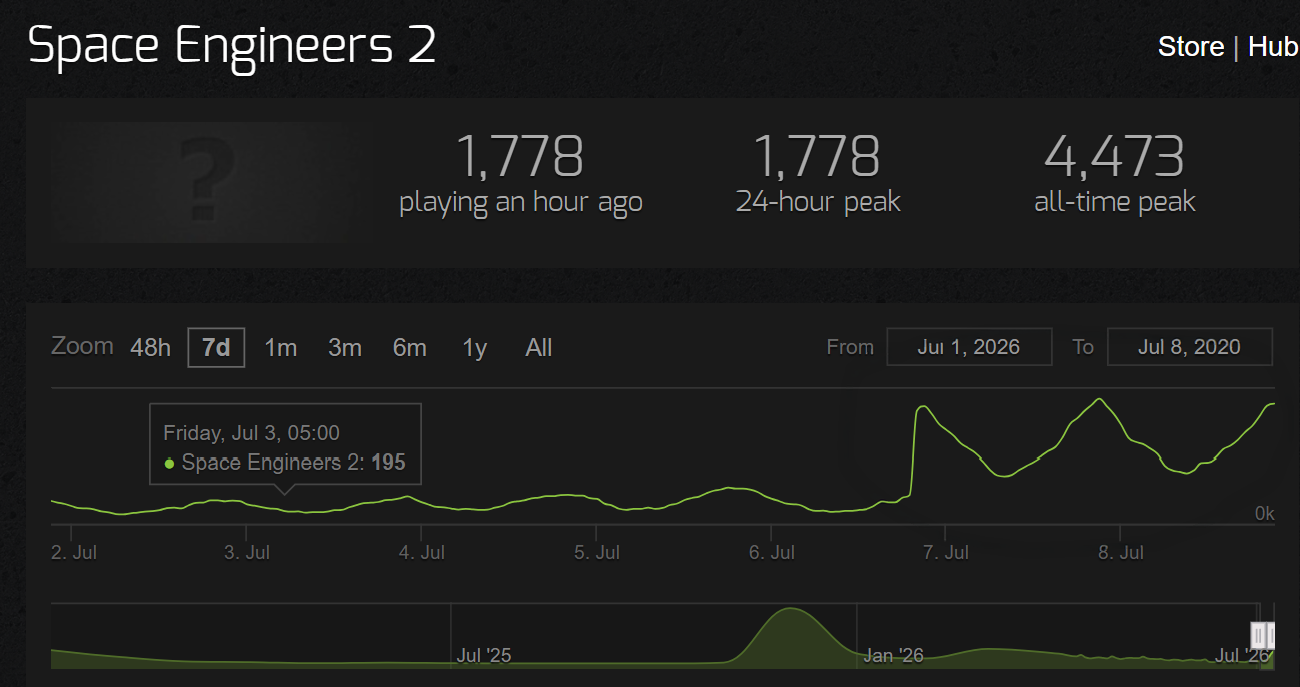
We also saw more players coming back to try VS2.3, which is an encouraging signal. It tells us that this direction is interesting enough for players to return, experiment, and give us useful feedback.
Why VS2.3 matters
For me, VS2.3 is not just a content update. It is a direction update.
Our vision for Space Engineers 2 has always been straightforward: we want to build a living solar system that gives players concrete engineering objectives, where you advance, explore, build, solve problems, and colonize.
Of course, if players prefer a freeform sandbox, they can have that too. That freedom is part of Space Engineers. But we also want the game to feel like an active world that gives you meaningful reasons to progress.
That is where VS2.3 matters. It gives players more verbs: drive, automate, detonate, repair, survive, travel, connect systems, complete contracts, and make engineering decisions that have consequences.
This is the direction we want to keep strengthening: more connected systems, more reasons to engineer, and more situations where the player says: “I can solve this if I build the right thing.”
Colonization and the active world
The colonization system is important because it gives engineering a larger context.
Space Engineers should not only ask: “What can you build?” It should also ask: “Why are you building it, where will you take it, and how does the world respond?”
Contracts, stations, sectors, mining, trading, exploration, encounters, resources, terrain, weather, vehicles, automation, and survival should all become connected parts of one larger progression loop.
You build vehicles because terrain and distance matter. You automate because bases and ships need to react. You mine and trade because resources are distributed. You complete contracts because sectors grow. You return because the world changes.
That is the long-term promise: a sandbox that remains free, but also becomes more alive for players who want direction, progression, and colonization.
What first contact taught us
The release also showed us where we need to improve quickly.
The main theme I see is trust and legibility. Powerful systems only feel good when players can understand and trust what is happening.
We are watching and working through reports around terrain/mining issues, G-menu and grid toolbar confusion, Control Panel grouping, hinge placement, Classic Survival resource progression, hydrogen/flight behavior, cockpit interaction, crashes, and other first-contact problems.
Some of these are bugs. Some may be UX or tutorial gaps. Some are expectation mismatches. But all of them matter, because they happen exactly where players are trying to understand the new systems.
So our next focus is clear: reproduce the most trust-breaking issues, hotfix what we can, improve communication where the system is correct but unclear, and keep listening to real player behavior.
Player excitement tells us the direction is right. Player friction tells us where trust and legibility must improve next.
VS2.3 is a big step toward the kind of Space Engineers 2 we want to build: a game about player agency, engineering consequence, colonization, and systems that combine into things we did not script.
Thank you for helping us test that direction. Now we keep improving it.
Asymmetric Destruction
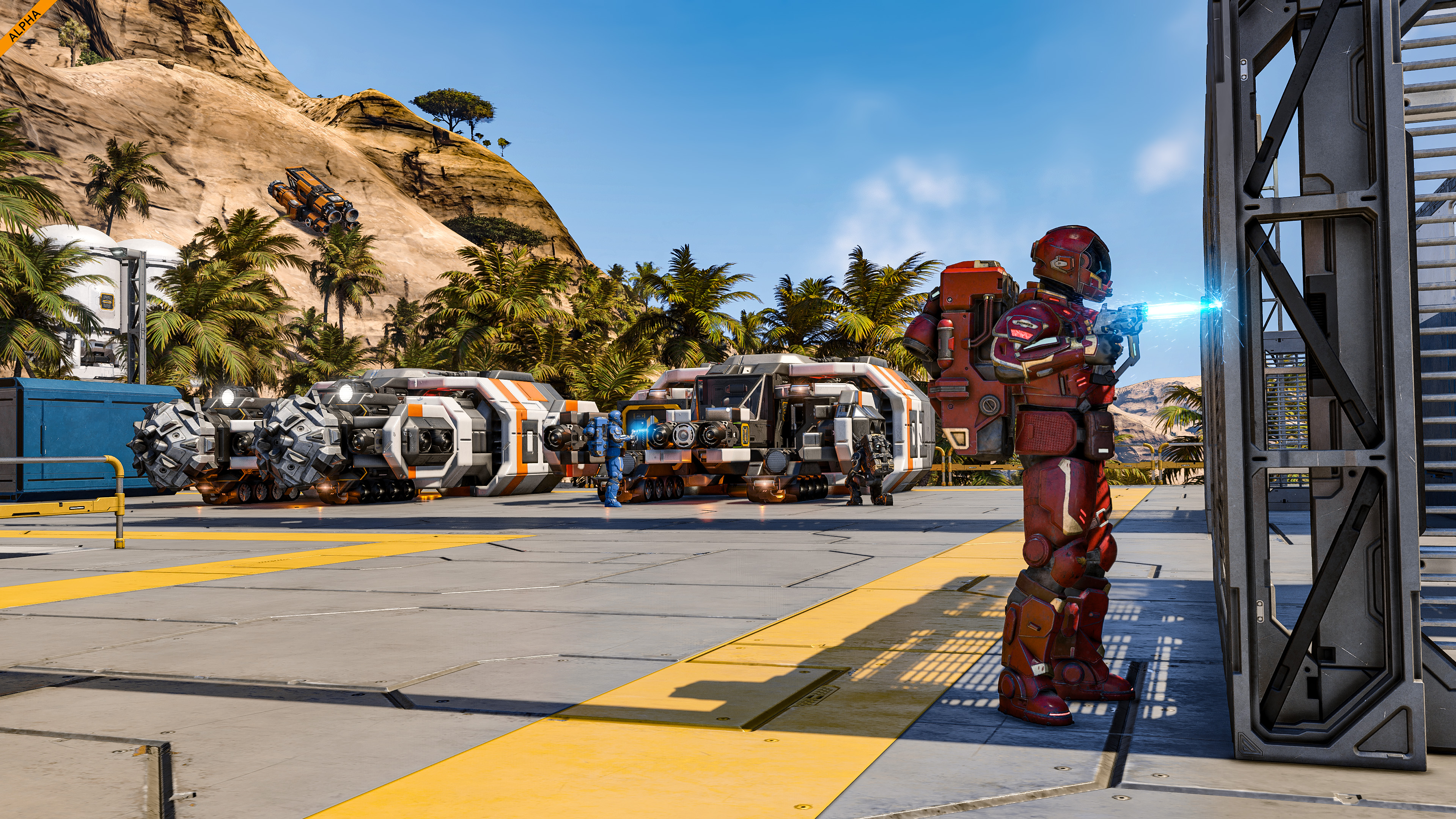
One of those improvements we are working on is Asymmetric Destruction.
The situation is simple: rovers and forests should not feel like two immovable objects arguing with each other. If you hit smaller flora with a vehicle, the result should feel natural, readable, and fun – not like the invisible spirit of a tree just deleted your suspension.
With Asymmetric Destruction, collisions won’t always affect both sides equally. Your multi-ton monstrosity of steel should be able to smash through flora without automatically taking the same damage back. So yes – plowing through trees like a manga villain should be possible.
This is not about removing consequences from driving. It is about making collisions feel more believable. If you crash into something serious, that should still matter. But if your rover is pushing through bushes or smaller trees, the game should understand the difference.
Question to you: What did VS2.3 get right for you?
Share your thoughts in the comments below – I read them all, and they’re one of my favorite parts of making our games.
Subscribe and get an email whenever I publish a new post!





Ugh… why does it read like it was written by LLM ;/
that’s been known though lol hes not fluent in english
I’ve always felt bad about destroying trees, since there’s no way to restore them in the same spot or anywhere else. After several hours of gameplay on a planet, there simply won’t be any forests left 🙂 Would it make sense to make them renewable? At least after some time… or give players the ability to plant trees in the right place, similar to how the voxel brush works with terrain.
Also, it wouldn’t hurt to add adjustable steering angle and steering speed settings for wheels.
@Борис Разживин agreed, I also feel like the world should provide us with the means to restore what was already there. In SE1 I felt bad about accidentally damaging terrain because I wasn’t able to restore it, and metal plates didn’t look so good.
I hope we will have such ability in SE2, of course with reasonable limits so people won’t be able to build stone voxels in bases only to reinforce them and make it more deadly for other vehicles to crash into it.
i 100% agree with the other 2 commenters but, the only easy way of integrating this type of functionality that isnt near impossible would likely be the no mans sky voxel respawn technique/a land claim system similar to a public minecraft smp, then you can select what terrain will permanently remain like that and what will naturally respawn according to the planet generating algorithim, and unclaim for areas you want to restore, maybe servers could also use this to limit the amount of voxels claimed by players to save on performance similar to PCU? this is my first time commenting here and i could genuinely be talking out of my ass so take it with a grain of salt and correct me if im wrong, tryna be constructive here not just critically hopeful lol.
I really like trees and plants for decoration too
“and even requests for future things like rails and trains.”
No way! Marek already knows what we would like to have trains. It may be a little far-fetched, though imagine how awesome would be it not only to have a planetary rail system, but rather a high-speed, inter-ship transport rail, akin to the one you might’ve seen in Wall-E.
Just imagine trains and underwater tunnels. Could it get any better?
Trains and rails are good, but let’s generalize any train as the abstraction of any arbitrarily-shaped grid sliding smoothly along any other arbitrarily-shaped grid. Think about how that would make things like massive hangar doors easier to build. Think about all the linearly sliding components of a massive TRANSFORMING BATTLESHIP as individual “trains”.
The current piston and rotor system is just far too intensive on physics calculations, and to build a train right now from first mechanical principles is too cumbersome and a waste of simulation speed for anything complex and grand, which breaks a lot of my “trust” as an ambitious builder. A rail and railcar that focuses on simplifying the physics and construction of grid-to-grid motion along a linear path is what I want. This is a case where oversimplification is a good thing, because the alternative ways to build a train now would still be available.
Hi Marek, I’m a confused by last video in post. Speed was not above safe speed limit / thats why it does not take damage. Does asymmetric damage means: I can in future land with multitone cruiser in the forest like Millenium Falcon from Star Wars VII on Starkiller Base in fast speed without taking critical damage?
It means if you slam your ship into the ground at max speed your ship will still be a hunk of scrap, but the crater you leave might be bigger than it otherwise might be, and if you landing a bit roughly on trees your going to do a lot more damage to the trees than to your ship, though that will still mean some damage to your ship
congratulations to you and the team for a fantastic update. i feel like you got a lot of things right.
my main convern is the new FTUE. it feels disjointed and clunky. i realise this new direction is in the early stages, but even I, as an experienced SE2 player struggled to understand what it wanted me to do at times.
i was thinking it would be good to have an “emergency drop-pod assistant” that does a voice over and talks the player through the opening stages of their journey and fades out as the player mives out of the range of the pod.
i even have some script ideas for it to help new players. if youre interested, let me know 👍
While VS2.3 is a huge step in the right direction and adds a lot of important blocks (and gladly in an acceptable size, I feared the event controller would be 2.5m again) and features, my main problem with SE2 remains that neither the survival nor the classic survival scenarios meet what I would call a satisfying survival experience.
In the survival scenario with the FTUI you get to space too quickly, you get a lot of resources, ships and bases and there is no voxel based ore farming asides from ore veins (rocks don’t yield resources). I don’t really wanna play this.
The classic survival scenario sets out to fix this, but here progression is missing. Everything is unlocked right from the start, there is no reason to go to space or accept contracts, etc. Colonialization is at 100%.
So idealy I would like a mixture of both scenarios: There is no tutorial, but voxel based resource farming. Only basic blocks and atmospheric thrusters are unlocked. You then need to find a station on Verdune (with your rover or atmospheric ship) where you complete a contract to unlock hydrogen thrusters. And so on. This way getting to space is a challenge, but it doesn’t end there, because once in space, you need to accept more contracts in order to unlock higher tier blocks.
This would really transform SE2 to the ultimative space survival game.
there is voxel mining tho
I like the idea of progressing through completing contracts (make those “milestone” contracts a little more challenging then the previous contracts) and thereby unlocking key components.
I really like to automate, so the event controller is a main component in grids for me. But I think it could use some improvements.
I suggest to have multiple programms running on one event controller (maybe three?). Or have one server rack where you put several CPUs (like the power-modules in the batteries) and each CPU handles one program.
I came back to see the LCDs and the new blocks, but had to realize a few hours in that my previous old save is no longer working. Later missions needed blocks that were not unlocked and I had no new mission to unlock them so simply they were not there and not able to progress, had to start a new save.
I had a thought, seeing all the wheely action – what if the start wouldn’t make you craft an aircraft but a rover instead?
I feel like making the first tutorial about an aircraft kind of diminishes wheels and rovers. If I have a flying vehicle why would I wanna dodge trees and bump around on the terrain? I think it would be a better start that after getting out of the landing pad, the crashed vehicle would be a rover, not a ship. Also with water coming in I’d make the staring area that drives the player through all – so out of the landing pod – > rover, then a waypoint to a shoreline POI -> building a ship -> go across the sea or pond, and only then I’d give the players atmo thrusters (and from there hydro and ion eventually..) It feels like we are getting flying too early so ground and water vehicles are meaningless, because everyone will choose to fly instead of anything else.
Hi Marek :).
First of all, I’d like to say that VS2.3 is, in itself, very well done. Admittedly, there are a few bugs in it, but these have already been diligently reported by other players. I’ll be writing something about that too.
But I have a question: it’s about the conveyor belt sorter, which still doesn’t work. Whilst it isn’t strictly necessary for full automation, it would be a great help. It would be brilliant if you could add the conveyor belt sorter’s function soon :).
Otherwise, I think the changes to the landscape, the automation system and the other changes and adjustments are very good, and I’m still looking forward to the co-op multiplayer and other future developments.
A part of me is happy about you writing about “concrete engineering objectives”, but another part demands evidence. What do I advance through? What problems do I solve? What do I colonize? Colonization suggests building faraway outposts and installations. How does the game encourage building those outposts? You don’t mean the “weld these 5 pre-placed blocks” type of contracts, do you? Stop tooting your own horn about the direction being right and player being excited. Cheering when you make your systems optional is not a sign of excitement and trust. It means your direction is wrong. And I complain because I don’t want you to create a garbage progression system and then make it optional so it hurts less.
Those contracts? They utterly fail at the goals you’ve stated. Delete them. All of them. I’ve written a piece of feedback on the Support portal that no one read (“Better contracts: Shipbuilding”) about what I wish the contract system would look like. In short: contracts ask for ship designs that fulfil certain criteria and send players on a short, scripted mission that allows them to test those designs. These are explicit goals; implicit goals usually just emerge out of the progression system, which is what contracts are currently the only form of. Another great source of engineering problems is combat. For example, you could have enemy fleets block fast travel routes and only enable fast travel after that fleet is defeated.
I’d really love to see native track support—without mods—for vehicles like tanks, all-terrain vehicles, or other heavy, slow, yet capable machines; you won’t get very far on wheels alone… pun intended.
Hello,
First off I want to say that Space Engineers has been a massive sandbox for me. I have over 5k hours in SE 1. I have a nerovisual functionality and it can be hard for me to focus on things if I don’t have my full capacity being used.
This series has been the baseline i’ve used for the back of my mind while problemsolving other maters that require my attention.
In other-words, what I am trying to say is the game excels at being simplistic but complex where it needs to be to function for me.
However,
Like engineering, everything should have a reason. You mention a few different aspects in your memo. When I see things that do not fit that logic, I have a hicup in my thought process. Tree’s and flora for example. Tree’s do not drop any resources, or, effect the atmosphere of the planet. The argument can be made that they function purely on astetic function to allow a player to conceptualize this as immersion when playing.
For me, This immersion is broke when i see the functionless tree. I ask myself, Why doesn’t it give me wood, seeds, leaves, sticks. Why can’t i make things like biofuel with these biproducts, why don’t they contribute to the planets atmosphere, terraforming, effecting biomes by replanting tree’s to help the planets deserts recover?
In SE1, There was an attempt to utilize these when food was implemented which was a relief for me.
Moving away from flora, I want to point out the terrain. The landscape is much more immersive in SE2 and is 10x more pleasing to the eye.
However,
I have been confused since SE1 that there is a foundational miss. In the real world, a construction crew shows up on a site and the first thing they do is adjust the terrain to accomidate the structure plans. This includes earth movers that can flatten terrain or dig specific dimentions. I have countless hours in spent using a hand held drill to sculpt the terrain to make dirt road trails only to have one mistake in the depth to cause a pothole i can not refill. Having a rover attachment that allows a bulldozer effect, or earth scrape effect would not only increase the easy application of such needs, but also increase the realizm. Voxel hands are “to me” not a acceptable system and lacks the depth of functionality to allow for ease of use while maintaining a complex functionality to fill the roles a player would want to use it for.
When it comes to resources, I have struggled to find deposits that even supply me with enough resources to create a simple light armor block floor that is 4×4 at my base. I had to create myself a mod to allow me to have resource deposits be valuable enough to justify the creation of a mining ship post 2.3.
The resource changes from SE1 have me quite disappointed as well. I do not understand why I can use raw iron to creat components directly. I suggest having at least the option of needing ingots again. The production pipeline now feels very unrealistic and disconnects me from the feeling of being apart of every step of the engineering process.
The fact that gravel is no longer used also greatly confuses me. even though SE1 only had a single use case for it, it is something that should have been expanded on in SE2 instead of removed. Cement structures should be able to offer a more realistic planetside road and building system than using metal blocks.
Making a shift over to ship/craft creation. I was excited to see wheels and wanted to see if I could experiance the new features in a organic way. Creating a new game, I was immediately reminded of the issue of gathering resources to even build a platform that has the proper production blocks and storage. I then went directly into building a aircraft that could mine. This gave me the realization that the rover has now effectively been bypassed and the fact I was going to build one was simply because I wanted to drive around. Otherwise, it provided no other value especially since the difficulty level of mining with a rover compared to an aircraft is 100x more difficult. This is something that has always caused my brain to skip a moment.
Most every ship in the game functions as a singular flight type. I see blueprints of people building 747’s which i love to see. I would like to see turbines, rotors, that can provide lift. This would allow for builds like helecopters to finally be a function. The flat atmo thrusters in SE1 was a huge steping stone towards this and I was disappointed to not see it in SE2 yet.
Overall, I buy every game and expansion to simply support Keen and the development, even if I am not able to enjoy it right away. I will continue to do this.
I am not sure if my view is unique from what other players are suggesting so I understand if these thoughts are counter productive to what others are asking for. I only write these things to offer my thought processes while playing.
I also understand that SE2 is a Alpha product. This is why I am here creating this post, to offer my thoughts.
I wish you and Keen all of the best and the good fortune that you and your team has worked so hard to be intitled to.
Thank you,
Joseph
I was waiting for mechanical blocks to be finished to really get into the sequel and im pretty happy with it all so far. I have a few questions and suggestions.
Q: Are you going to continue adding settings and parameters to the mechnical blocks? At least to match their SE1 counterparts, we are missing the ability to lock rotors in place, the “share inertial tensor” for pistons (sorely needed as a stack of pistons sags heavily at the moment), and we need the text readouts in the control panel of current piston position and current rotor angle
Q: I was under the impression that only bug fixes and optimizations will be added aside from VS3/4 until both of those are out. Does that really mean absolutley no new blocks/ added parameters etc until next year? Thats a huge bummer. I would highly suggest a couple people work on some beautiful detailing/ decorative blocks in the meantime
My first impression in Classic Survival was
“What, there is no survival kit and no energy source to recharge the battery? Holy crap, I neeed to build those and I actually have to manage my time and resources here!”
A pleasant surprise. This start does give you a challenge, however easy, right from the start.
Wheels are in a horrible place! They are missing critical funcitonality!
Steering toggle, steering min/max, suspension tuning, height offset, and missing sizes, etc means that wheels, although existing in SE2 with basic funcitonality, are almost totally useless! This update though providing interesting funcitonality, is hardly a vertical slice if the important content of the vertical slice is missing!
Out of all of this, Asymmetric Destruction is the most exciting for me. I am immediately imaging a huge starship crashlanding on the planet, obliterating hundreds of trees as it plows through the landscape to a stop. In the older game, you would just pretty much get shredded by trees as if they are made of tungsten 😂
Love VS2.3! Here is a QOL improvement suggestion:
– Overcrowded GPS Markers in Classic Survival:
It’s polluting the screen when you want to look around for your custom markers, and also when you create new markers it’s a hassle trying to find your “newly created one” — A QUICK SOLUTION would be to make so that we can hide the station markers in the GPS menu… A FUTURE/extra SOLUTION would be to have a pre-world-start options menu of how you want to start your classic survival, one of the options is being “Undiscovered System” so that we can discover the planets ourselves and have that big popup of “New Discovery” while we traverse the sola system.
Hey Marek, I’ve got some pretty intriguing suggestions for SE 2. (Skip to the bottom for the technical description)
I’m an avid player of SE 1, and recently got SE 2. I’ve found that SE 2 feels just like SE 1. I do not mean that in offense, but I have some qaint, easy to implement optimizations and physics manifold constraint suggestions that I would be happy to share.
I have noticed that SE 2 still fights some of the legacy instabilities of VRage 2, and I have some suggestions regarding Inverse Kinematics and vectorized force transfer systems that could largely reduce or eliminate Klang, without hampering or distorting the sheer amount of interactivity and liveliness of the game.
I primarily talk through Discord, and use the same username. I am also in the Keen Software House Discord server.
I would be elated if you would grace me with the privilege to share some of my views and suggestions on the game, and allow criticism both ways.
While I do understand that the workload with SE 2 is enormous, I would be grateful if you could find the time and/or opportunity to speak with me.
My ideas largely concern the use of SIMD, CPU cache continuity, phantom ray meshing for pre-computation, and a humongous opportunity for multi-threading while simultaneously increasing accuracy, maintaining sync across multiplayer, and devising easy methods to construct pieces of the engine to avoid spaghettification through proper documentation and low-level hardware architecture analysis.
Thanks,
Quarry.
I know you have said in the past that steam deck support might be added.
That would be so cool as steam deck needs games like space engineers two. If the idea is still being thrown up there when will it be added?